


We are living in an era of uncanny synchronicity, where high-level geopolitical cynicism rhymes seamlessly with our daily dead ends.
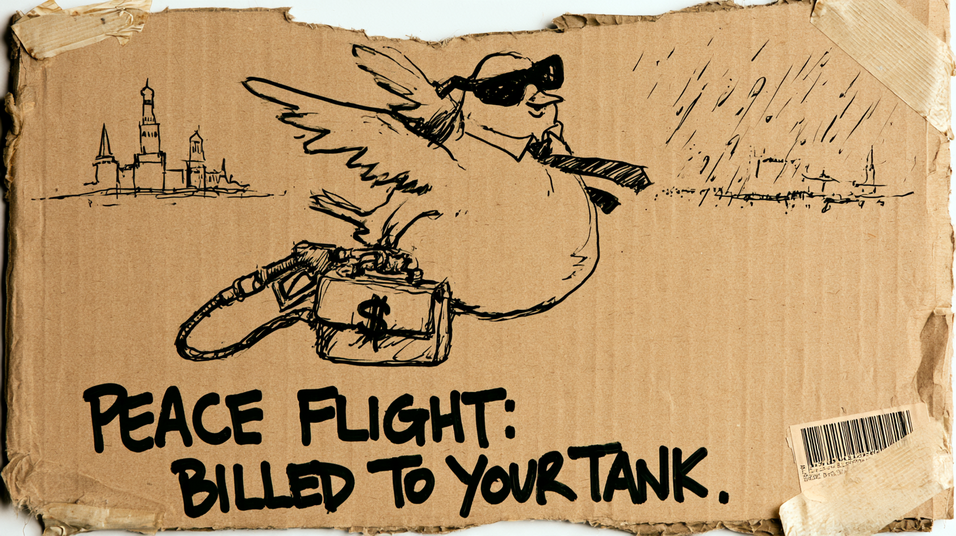
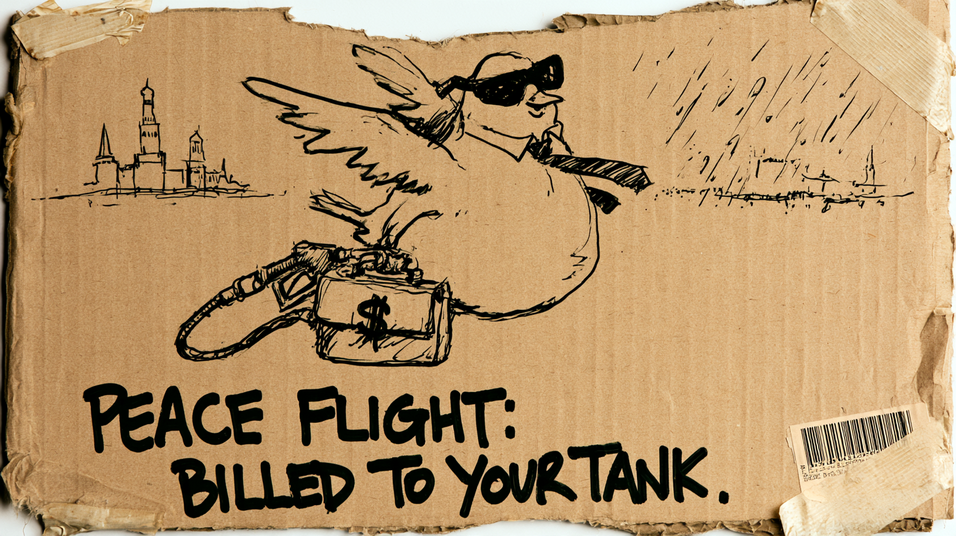
It all begins with grandiose gestures. American emissaries with commercial pedigree land in Moscow and Kyiv, carrying a “rapid peace blueprint” — a product primarily packaged for domestic consumption back home. The underlying calculus is disarmingly raw: freeze everything along the frontline trenches, push global crude prices down to deliver cheap gasoline at American pumps, and offload the entire invoice for this purported “armistice” and reconstruction directly onto Europe.
In this match, Europe plays the quintessential solvent spectator, denied any veto power. While officials sketch buffer zones across maps, a driver in the south of France stares at the gas station display charging 2.25 euros per liter of diesel, glances across the border at Spain sitting around 1.60 euros, and quietly wonders where his virtuous sacrifice for strategic independence morphed into a fiscal noose. When oil turns into high-stakes diplomacy, the bill is always footed by the one holding the nozzle.
Yet while Europe chokes on institutional inertia and tax revenues, back home in Ukraine, that very same dynamic takes on an almost literary dimension.
People love to repeat that the war will reset everything, that a brand-new generation will rise to break the back of systemic corruption because they “never breathed Soviet air.” We genuinely waited for these clean-cut reformers. And they arrived: sharp, articulate, speaking fluent English, and carrying signs made out of corrugated delivery boxes.
The “cardboard protest” marked the absolute apex of our political theater. Gone are the days of haggard pensioners waving party banners for a couple of bank notes. Everything has gone boutique: kraft cardboard, clever markers, viral tracks for social feeds, authentic outrage, and demands to keep a “progressive minister” in office. Exactly two weeks of high energy, photo-ops, and civic adrenaline — followed by a denouement straight out of a satirist's playbook: the minister accepts an advisory post on defense innovation in sunny Rome, and the street protest dissolves like morning mist over the Dnipro.
The most catastrophic error is to assume that the people running corruption schemes are fools. Fools do not survive three changes of administration, nor do they navigate multi-billion cash flows in the midst of an existential war. Behind the curtain sits a cold, disciplined, and technologically savvy mindset.
Today, a legacy operator doesn't even need to employ crude spin doctors. With funds shaved off defense contracts, they simply buy enterprise subscriptions to top-tier AI models. The very same neural network designed to catch VAT evasion and cross-reference shell companies is repurposed to decode public vulnerability:
- it calculates the fatigue curves across social networks;
- it engineers the perfect emotional hook for the youth;
- it prescribes the exact shape of an innocuous “cardboard release of steam” so that, beneath the generated outrage, the actual procurement sign-offs can slide through unnoticed.
Some find grief in war; others find an algorithm to monetize it. Technological progress hasn’t eradicated fraud; it has merely provided corrupt networks with surgical instruments, rendering systemic cynicism nearly invisible to the untrained eye.
When the cycle finally runs full circle — from 96 hours of tactical “calm” staged for visiting envoys to the next budget carve-up insulated by viral noise — only one unvarnished truth remains. There is no mythical generation that will shoulder the burden simply because of their birth certificate. And no cardboard placard will ever pierce the reinforced concrete of a machine that knows how to monetize its own scandals. The only real defense is unyielding discipline: refusing quick miracles, mistrusting visiting peacemakers, and methodically dissecting their financial trails page by page, registry by registry, until facts outlast the algorithms.






Залишити коментар