
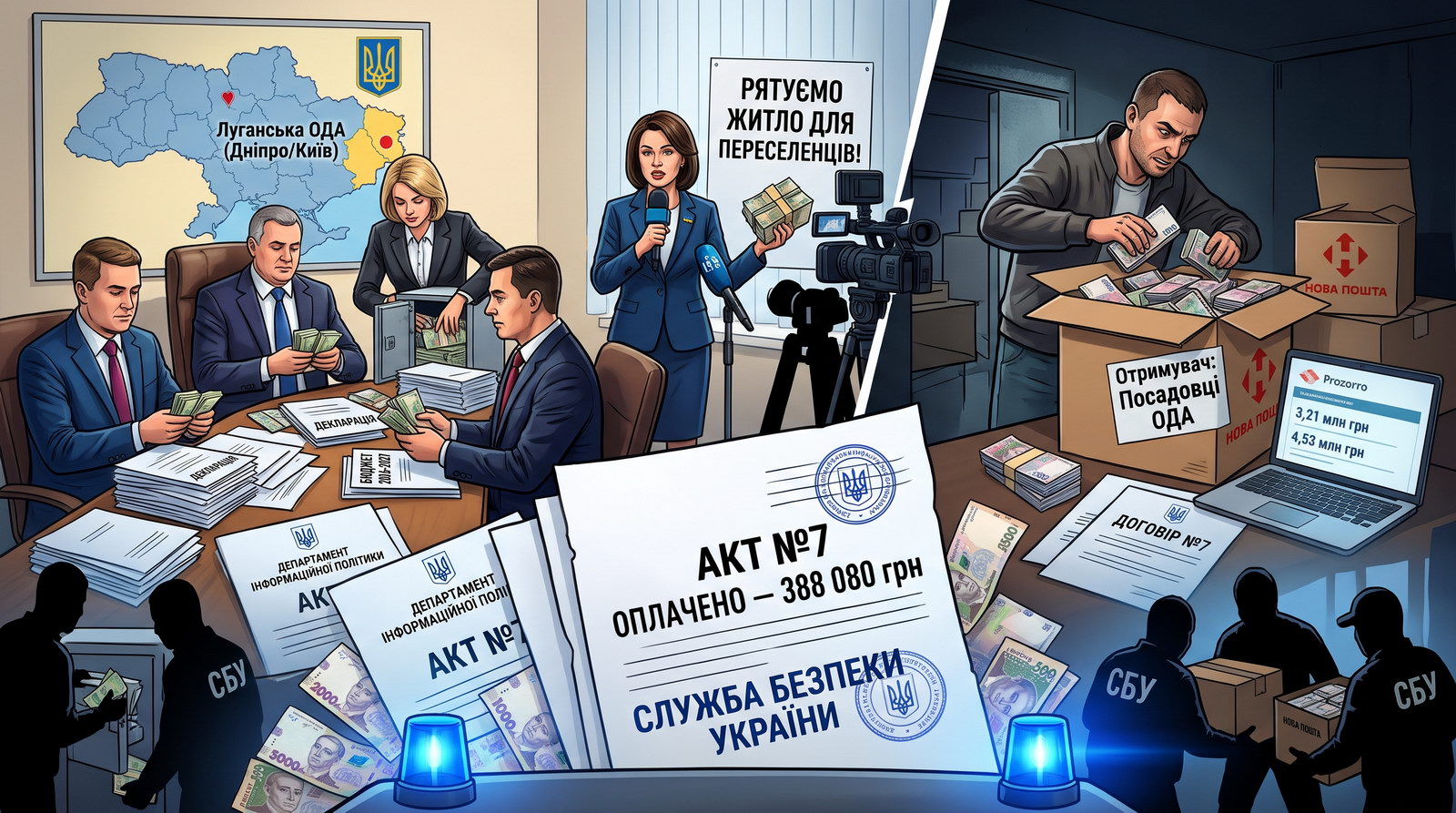

While local authorities in some Ukrainian regions spend public money on "soft" covert advertising (jeans) to polish their political image, the relocated Luhansk Regional Military Administration (OVA) displays a far higher level of cynicism. Amid a criminal investigation into large-scale budget embezzlement by an organized criminal group and a secret payout to a contractor made after Security Service of Ukraine (SBU) raids, the regional leadership has launched a media campaign to retain control over regional funds in 2027—using housing for internally displaced persons (IDPs), released prisoners of war, and military aid as a shield.
Manufactured Crisis: How the OVA Threatens IDPs With a "Budget Hole"
On November 25, 2026, at a conference in Kyiv, Luhansk Regional State Administration Chief of Staff Nadiia Kalihaieva stated that the 2027 housing program for displaced persons was at risk of cancellation. The reason cited was the central government's plan to withdraw unspent budget surpluses from occupied territories and communities under the 2027 State Budget for centralized redistribution toward IDP needs.
The resulting article published by Realna Gazeta follows textbook crisis-PR tactics. In a single emotional narrative, the official bundled together the most sensitive issues: housing loans for Luhansk residents, children's rehabilitation, support for the Defense Forces, and assistance for first-wave IDPs (displaced since 2014). Comments from the Ministry of Finance or relevant line ministries are entirely absent—leaving readers with a single takeaway: the relocated administration is allegedly the last line of defense for Luhansk residents, while the central government wants to strip them of funding.
Behind this public display of concern, however, lie two documented facts: how the Luhansk OVA continued paying millions to a criminal suspect even after arrests, and how much maintaining the evacuated administrative apparatus costs taxpayers.
Rivne vs. Luhansk: Covert PR vs. Organized Crime and Post-Raid Payouts
To grasp the scale of the disparity, one only needs to compare how budgets for "media coverage of official activities" operate in rear-area Rivne versus the relocated Luhansk OVA.
A recent investigation by the Institute of Mass Information (IMI) in Rivne exposed a classic regional model of "soft covert PR": the city council and regional administration fragmented UAH 1.36 million across dozens of small contracts with friendly local media outlets and sole proprietors (FOPs). Without mandatory "Advertisement" labeling (a direct violation of Article 9 of the Law "On Advertising" and Article 13 of the Law "On the Procedure for Covering the Activities of State Authorities"), these outlets ran complimentary stories about officials, billed UAH 7,500 for republishing free press releases, and accounted for EU Interreg NEXT grant funds without even listing the titles of aired broadcasts. It is a standard mechanism for buying local media loyalty.
The Luhansk OVA case, by contrast, goes far beyond journalistic ethics—it involves criminal proceedings under Part 4, Article 191 of the Criminal Code of Ukraine (embezzlement of property on an especially large scale), which a court reclassified in November 2026 as the actions of an organized criminal group:
- UAH 4.53 million funneled to a single entrepreneur: According to State Treasury accounting records under budget program KPKV 2310180, sole proprietor O. A. Smetankin absorbed departmental funds two years in a row. In 2025, under Contract No. 12/7, he received UAH 1,799,998.86 (6 completion certificates), and in 2026, under the controversial Contract No. 7 (tender UA-2026-03-13-012479-a), an additional UAH 2,733,885.00 (7 certificates)—totaling UAH 4,533,883.86.
- The "80/20" kickback scheme and cash parcels: According to investigators, the tender winner funneled 80% of the funds through a fictitious subcontract to an entrepreneur in Kropyvnytskyi for cash withdrawal, after which bundles of banknotes were mailed via Nova Poshta parcels directly to OVA officials.
- Document forgery and a payout after SBU raids: Completion Certificate No. 1 under the 2026 contract was signed 11 days before the contract itself was even executed. Yet the most striking development occurred after September 3–5, 2026, when the SBU conducted raids and served notices of suspicion to Department Director Albina Kushelieva and her deputy. On October 5, the department's new leadership signed the final Completion Certificate No. 7 with the very same contractor for UAH 388,080, submitting it to the Treasury on October 9. Although Acting Director Roman Mamedov assured journalists in writing on October 22 that the invoice was "unpaid" (an act bearing signs of providing false information under Part 2, Article 212-3 of the Code of Administrative Offenses), an official response from the State Treasury on November 24, 2026, confirmed that the entire UAH 388,080 was paid in full.
|
Comparison Metric |
Rivne Case (City Council + OVA) |
Luhansk OVA Case (UA-2026-03-13-012479-a & 2025) |
|
Total Budget |
UAH 1.36 million (fragmented across dozens of deals) |
UAH 4.53 million to a single FOP in 2025–2026 (UAH 2.73M paid in 2026) |
|
Execution Model |
Fragmentation: 54 city contracts + 14 OVA deals via local media and FOPs |
Monopolization: rigged tender tailored for a pre-selected pass-through vendor |
|
Financial Conduit |
Direct contracts with editorial offices or small FOP intermediaries |
Rigid "80/20" subcontracting scheme for cashing out funds |
|
Profit Mechanism |
Political rent, editorial loyalty to city and regional leaders |
Direct criminal kickback: shipping cash via Nova Poshta parcels |
|
Pricing Structure |
Chaotic: from UAH 385 to UAH 54,000 for a document scan; UAH 7–8k per story |
Fixed: exactly UAH 1,155.00 per content item per accounting records |
|
Document Integrity |
Contracts and certificates provided (despite one unit's attempt to hide data) |
Official forgery (certifying work 11 days pre-contract) + concealing the UAH 388k payout |
|
Legal Status |
Violations of advertising and public information access laws |
Criminal proceedings (Art. 191(4) CC, organized crime), indictments, arrests, bail |
The UAH 4.53 million paid to a single contractor for "publicity" alone would have been enough to purchase several apartments outright or cover preferential mortgage down payments for a dozen displaced families whose interests the OVA leadership claims to champion.
The Price Tag: What the Defenders of the Regional Budget Earn
The primary reason evacuated Luhansk OVA officials fight so fiercely to preserve their regional budget becomes clear upon reviewing their 2025 asset declarations (filed in spring 2026). Maintaining the relocated administrative vertical in Dnipro and Kyiv costs taxpayers millions of hryvnias every year.
Key speakers and figures involved in the OVA's operations enjoy substantial financial stability:
- Nadiia Kalihaieva (OVA Chief of Staff) — the official publicly warning of housing program cuts in 2027 and holding citizen receptions in Dnipro. She has held senior administrative posts since Serhii Haidai's tenure, surviving three consecutive regional governors (Haidai, Lysohor, and incumbent Kharchenko). For 2025, she declared UAH 1,102,349 in salary (approx. UAH 91,862/month gross, or ~UAH 70,700 net). A year earlier, her salary was even higher at UAH 1.15 million.
- Albina Kushelieva (Suspended Director of the Information Policy Department) — the central figure in the criminal probe into media procurement. In 2025, her salary rose by over UAH 200,000 compared to 2024, reaching UAH 979,228 (an average of UAH 81,602/month gross). In September 2025 alone, she filed a notice of substantial asset changes following a one-off payout of UAH 210,046. Her 2025 declaration also lists USD 40,000 in cash (up $10,000 year-over-year) and an apartment in occupied Luhansk.
|
Official & Position |
2025 Salary (Gross) |
Avg. Monthly Salary (Approx.) |
Savings, Real Estate & Vehicles |
|
Oleksii Kharchenko Head of OVA (since April 2025) |
UAH 1,312,624 (UAH 1,011,980 at OVA + UAH 300,644 at Sievierodonetsk MVA) |
~UAH 118,000 (over 8.5 months at OVA) |
Cash: $59,000. Bank accounts: over UAH 134,800. Assets: Opel Corsa (2007), rented apartment in Dnipro (sold a Mercedes-Benz GL400 for UAH 1.23M). |
|
Oleksii Smyrnov Deputy Head of OVA |
UAH 1,703,551 |
~UAH 141,962 |
Highest annual salary among regional leadership (including bonuses and financial aid). |
|
Kateryna Bezhynska Deputy Head of OVA |
UAH 1,519,115 (+ UAH 210,129 pension) |
~UAH 126,593 |
Assets: husband's apartment in Kyiv (53.9 m²) and real estate in occupied Luhansk Oblast. |
|
Nadiia Kalihaieva OVA Chief of Staff |
UAH 1,102,349 |
~UAH 91,862 |
Cash: UAH 30,000, $800, €600. Bank accounts: UAH 121,822. Assets: house (59.7 m²) and land in Kramatorsk, 50% of an apartment in Donetsk. No personal car. |
|
Albina Kushelieva Director of Info Policy Dept. (suspended) |
UAH 979,228 |
~UAH 81,602 |
Cash: $40,000 (+$10k over the year). Assets: apartment in temporarily occupied Luhansk. |
Conclusion
Just five senior officials of the Luhansk OVA received over UAH 6.6 million in salaries from the budget in a single year. Over eighteen months, the department also transferred UAH 4.53 million to a single contractor for "information services"—paying out the final UAH 388,080 even after SBU raids and formal indictments, while publicly misleading journalists that the payment had been blocked.
Consequently, when relocated officials warn that reallocating regional budget surpluses in 2027 will deprive displaced persons of housing, it reads less like advocacy for Luhansk residents and more like an effort to safeguard their own financial trough. As Treasury records and court filings demonstrate, when funds remain under the OVA's control, a substantial share goes not toward apartments for IDPs, but toward million-hryvnia administrative salaries, bonuses for deputies, and settlements with targets of criminal investigations.
Note: Pursuant to Article 62 of the Constitution of Ukraine, a person is presumed innocent of committing a crime and shall not be subjected to criminal punishment until their guilt is proved through legal procedure and established by a court verdict of guilty.







Залишити коментар