


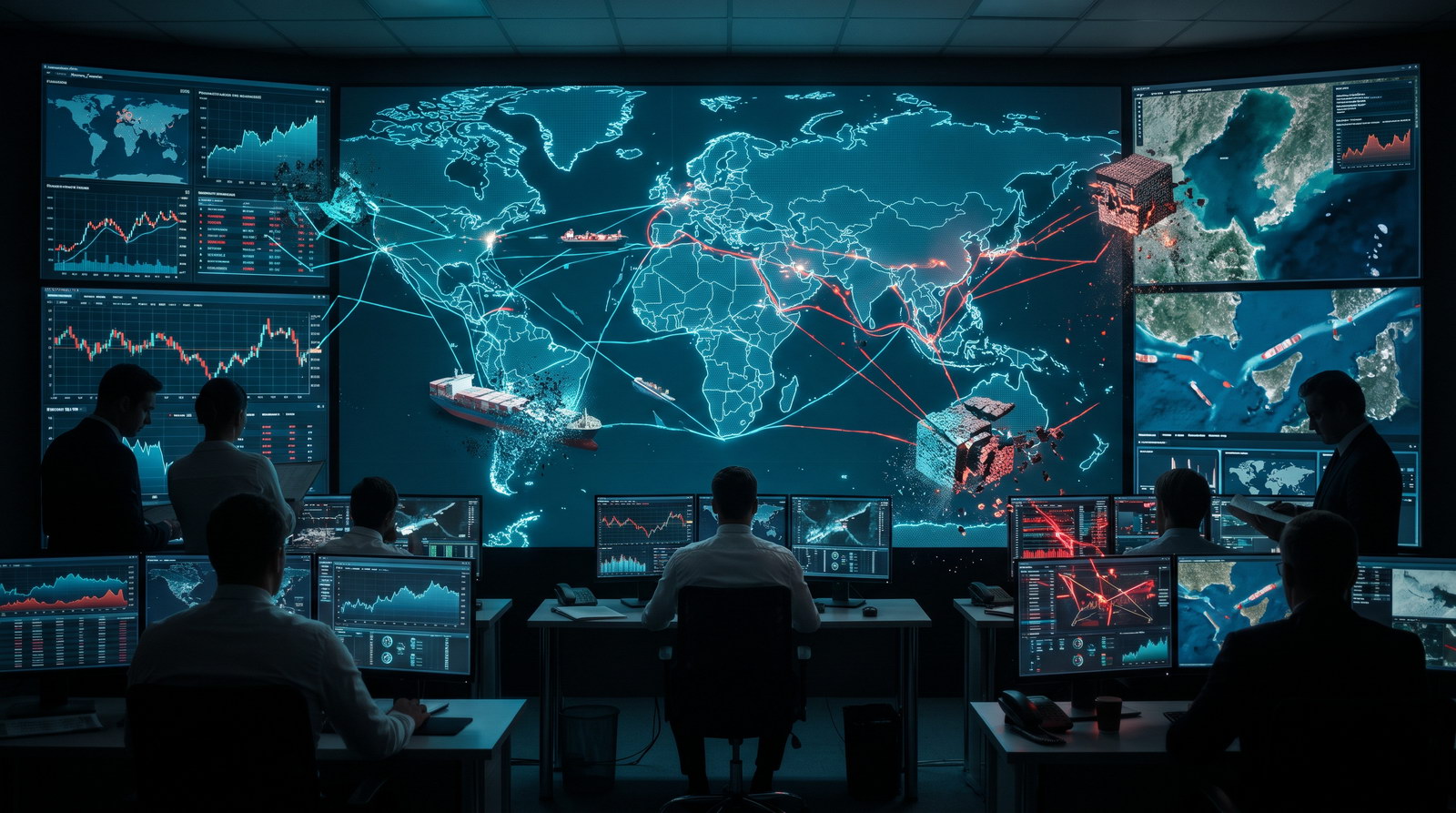

Final installment of the Dialogue Party special project: how the crash of China’s tech markets, the crypto crackdown following the Binance hack, and depleting financial reserves close the sanctions loop around Russia’s military-industrial complex.
The first six installments of our investigation unpacked the architecture of shadow warfare step by step—from the London transit of sanctioned metals and Black Sea sabotage to the crypto gateways of the A7 Network and the cash-flow crunches of Russia’s defense sector. In this concluding report, we connect these threads at the global level and demonstrate why autumn 2026 marks the point of systemic collapse for the entire sanctions-evasion coalition.
1. The Liquidity Scissors: Why Beijing’s “Lifeline” Is Cracking
Throughout 2024 and 2025, China served as the primary shock absorber for Russia’s war economy—both as a supplier of machine tools and electronics and as a source of yuan liquidity. By late 2026, however, the Chinese financial model itself entered a phase of severe stress-testing.
Amid the unwinding of the global speculative cycle around artificial intelligence and the rising cost of capital, Shanghai’s tech-heavy STAR50 index plunged 39.8% from its July peak on October 26, 2026, wiping out $480 billion in market capitalization[cite: 50]. Shares of leading Chinese GPU developers (MetaX, Moore Threads) lost half their value, while high-speed optical module manufacturers (Zhongji Innolight, Eoptolink) fell 60% as Washington prepared direct import bans targeting their equipment[cite: 53].
For Moscow, this reversal delivers a double blow:
- Scarcity of Free Liquidity in the PRC: Chinese state-backed funds (China Reform Holdings, China Chengtong) are forced to spend billions of dollars stabilizing their domestic stock market and absorbing losses at homegrown AI labs amid a prolonged real estate slump and weak domestic demand[cite: 57, 58]. Financing toxic external projects is no longer a priority.
- Fear of Secondary Sanctions: As the cost of raising equity capital for Chinese tech suppliers surged[cite: 53, 60], the risk of being blacklisted by the U.S. Treasury for shipping dual-use components to Russia became an existential threat.
2. End of the “Safe Haven”: The Post-Binance Crypto Crackdown
As detailed in Part 5 of our series, once traditional SWIFT banking channels were severed, shadow imports migrated to stablecoins and cross-border clearing pools such as the A7 Network. On November 1, 2026, however, this infrastructure suffered a decisive regulatory rupture.
The massive cyberattack on the Binance cryptocurrency exchange—resulting in the theft of $6.3 billion in digital assets, which the FBI officially attributed to the North Korean state-sponsored group Trader Traitor (previously linked to the $1.5 billion Bybit heist)—permanently altered the rules of the game[cite: 73, 74]. Crypto gateways shifted overnight from the realm of “gray finance” into a direct national security priority for the United States and G7 nations[cite: 73, 74].
For Russian importers, this triggered an immediate spike in clearing costs. Intensified blockchain surveillance, the freezing of mixing protocols, and strict compliance checks on custodial services across Central Asia pushed cross-border transaction fees to 10–14%, rendering multi-layered intermediary chains financially unviable for defense contractors.
Interactive Map: Collapse of Axis Shadow Gateways and Contraction of Buffer Zones (November 2026)
The interactive map below tracks the three primary vectors of this global squeeze: the technological chokepoint in the PRC (tech_choke), the toxic military-crypto bridge with North Korea (dprk_bridge), and the withdrawal of neutral transit buffers (buffer_exit). Toggle the layers and phases to compare the summer transit peak against the autumn 2026 crunch.
3. Toxic Barter: The Real Price of North Korean Lend-Lease
With foreign-currency accounts frozen and yuan clearing stalled, Moscow has been forced to offset its “TNT and artillery shell deficit” (examined in Part 6) through direct barter with Pyongyang.
The maritime corridor linking the ports of Rason and Nampo to Russia’s Far East has become the main supply artery for artillery munitions and ballistic missiles. Lacking freely convertible currency, the Kremlin settles its bills with Kim Jong Un’s regime in a strategically perilous form: in place of cash, Moscow transfers critical missile and space technologies, guidance systems, fuel, and food quotas. This arrangement not only depletes Russia’s own technological reserves, but also makes it an active accomplice to nuclear proliferation in Asia—alienating even cautious states across the Global South.
4. Closing the Buffers: Why Asia and the Middle East Can No Longer Rescue Transit
The energy shock sparked by the conflict surrounding Iran and the maritime crisis in the Strait of Hormuz in 2026 drove global Brent crude prices up to $112–114 per barrel[cite: 67, 70]. Contrary to the Kremlin’s expectation that high oil prices would automatically plug its budget deficit, the opposite effect took hold:
- Soaring Logistics and Insurance Costs: Freight rates for the “shadow fleet” multiplied, while steep price discounts on sanctioned Russian crude erased the market price premium.
- Pragmatism Across ASEAN and Central Asia: In an era of expensive capital—with the Federal Reserve holding interest rates at 3.75–4.00% and 10-year U.S. Treasury yields hovering near 5%[cite: 60]—transit jurisdictions from Singapore and Malaysia to Kazakhstan and Kyrgyzstan are rigorously filtering transactions[cite: 42, 44]. No regional bank is willing to risk losing access to dollar liquidity in order to clear toxic Russian contracts.
Series Conclusion: Anatomy of a Systemic Dead End
Across seven installments, the Dialogue Party investigation documents the transition of sanctions and military-economic pressure from a quantitative phase into a qualitative breakdown. The hybrid survival architecture built by the Kremlin since 2022—relying on shell traders in London, falsified certificates of origin, Balkan ports, A7 Network crypto mixers, and parallel imports—has exhausted its margin of safety.
When a federal cash crunch collides with an inability to purchase chemical precursors even for gold, and key “allies” are forced either to bail out their own markets or demand nuclear technology in exchange for shells, a war machine loses its capacity to reproduce itself. The shadow fortress has collapsed from within—under the weight of its own financial and technological insolvency.
Special Project Complete: All 7 Parts of “Anatomy of Shadow Warfare and Sanctions Evasion”
You have read the seventh and final installment of the cross-border investigative series by Dialogue Party. Explore the complete cycle:
- Part 1: London Transit: How China’s Largest State Bank Washes Russian Metals Bypassing Sanctions
- Part 2: Maritime Loop: How Attacks in NATO Territorial Waters Cover Russia’s Black Sea Shadow Exports
- Part 3: Anatomy of the Shadow Corridor: How Rules of Origin and Transit Jurisdictions Launder the Kremlin’s Resources
- Part 4: Hybrid Front: Maritime Strikes Near NATO Coasts, Orbital Intimidation, and Beijing’s Bulgarian Beachhead
- Part 5: Financial Web: A7 Network, Stablecoins, and Cross-Border Crypto-Clearing
- Part 6: Cash Crunch and TNT Deficit: How Backline Strikes and the Clearing Dead End Break Russia’s War Economy
- Part 7 (Current): The Last Fortress of the Shadow Axis: Collapse of Secondary Gateways, Technological Default, and the Price of North Korean Lend-Lease






Залишити коментар