



France is experiencing a culinary generational shift. An increasing number of young chefs are turning away from heavy, classic traditions in favor of locavorism (cooking exclusively with local, seasonal ingredients) and zero-waste philosophies.
A key indicator of this transformation is the Michelin Green Star (Étoile Verte), a dedicated award introduced in 2020. It is bestowed not for knife technique or plating elegance, but for environmental responsibility: zero-waste management, carbon footprint reduction, local sourcing, resource conservation, and direct support for local farmers.
Today, we explore this theme through the journey of one of contemporary France's most striking, uncompromising, and driven chefs: Florent Ladeyn. Looking at his flagship restaurant, Auberge du Vert Mont (located in the town of Boeschepe), we examine how "radical locavorism" works in practice and how it earns a Michelin Green Star.
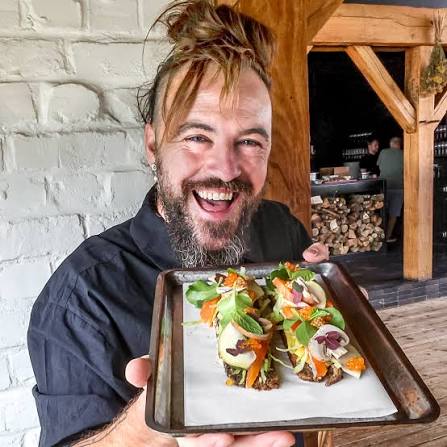
Photos Sébastien JARRY pour @lavoixdunord
"Florent Ladeyn is a French chef born on June 5, 1984, in Hazebrouck, famous for his locavore cuisine and his commitment to preserving Flemish terroir. He heads the Auberge du Vert Mont in Boeschepe"
First and foremost, Florent eliminated all imported and "conventional" fine-dining ingredients not produced within his region (Flanders / Hauts-de-France):
- No citrus, black pepper, or olive oil: to achieve acidity without lemons, he uses local sorrel, rhubarb, fermented products, and unripe berries. Olive oil is replaced with rapeseed, flaxseed, or camelina oil.
- No coffee or chocolate: standard post-meal coffee is absent from the menu, replaced by brews made from roasted chicory, barley, or locally forageable herbs.
- No tuna or vanilla: only local freshwater or coastal fish paired with Northern botanical spices.
Why this radical approach?
Ladeyn has proven that environmental responsibility in the restaurant industry is not a marketing stunt, but a genuine economic and ecological manifesto:
- Zero-carbon logistics: virtually all produce arrives from farmers and foragers operating within a 45–50 km radius of the restaurant.
- Local economic support: by paying producers directly, he fosters a sustainable micro-economy surrounding his establishment.
- Unforgiving seasonality: menus do not merely change per season, but adapt day-to-day based on what local farmers deliver or what is gathered from the forest.
Auberge du Vert Mont
Location: 1318 rue du Mont-Noir, 59299 Boeschepe, France.
Accolades: MICHELIN Star and MICHELIN Green Star (Étoile Verte).
Cuisine style: 100% locavore and radical (no citrus, chocolate, coffee, or exotic spices), focused on wood-ember cooking, wild botanicals, and Flemish produce.
Menu & pricing: "Petite balade" menu — €50 (lunch only), "Expérience totale" menu — €80, beverage pairing — €30 to €45 (or non-alcoholic pairing from €25 to €35).
Reservations: Official website of Auberge du Vert Mont.
Yet, while Flanders served as Ladeyn's primary muse in northern France, how is this "green wave" taking shape in the mountainous heart of the country — Auvergne?
This region of volcanoes and pastures is rethinking its heritage just as radically:
- Le Clos des Sens (Laurent Petit / Franck Derouet) — established a benchmark for 100% lake-and-plant-based cuisine by completely removing meat in favor of local alpine lake fish and harvests from their own permaculture gardens.
- Auberge de la Tour (Renaud Darmanin in Marcolès, Cantal) — an example of fine dining reviving a small village: the chef personally gathers wild herbs and mushrooms on the slopes of the Cantal mountains while working hand-in-hand with local foresters and farmers.
- Le Jardin des Miracles (and local eco-bistros in Clermont-Ferrand) — demonstrates how Green Star principles and short supply chains seamlessly adapt to modern urban formats.







Залишити коментар