


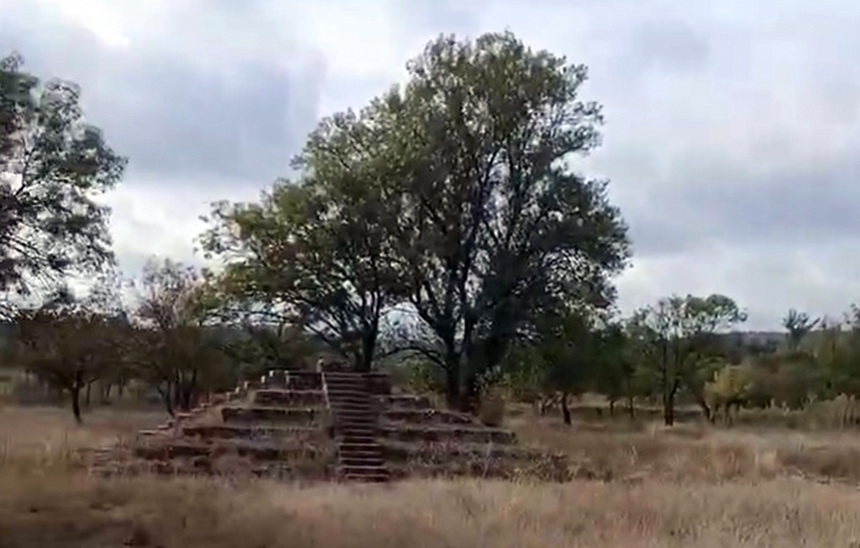

If you wander just north of the winemaking village of Cazouls-lès-Béziers in southern France, you will stumble upon a striking sight. Amidst the dense greenery on the banks of the Orb River stand monumental pyramids made of wire mesh and river stones. They look like the ruins of a forgotten civilization or a backdrop for a post-apocalyptic movie. Is it an abandoned art installation or a strange architectural whim?
Welcome to the Domaine Départemental de Savignac, a six-hectare natural park managed by the Hérault department. Behind this mysterious landscape, which local information boards poetically call "Le secret des pyramides" (The Secret of the Pyramids), lies a fascinating piece of 1980s eco-engineering.
From an Industrial Quarry to a Natural Oasis
Long before it became a peaceful park for family picnics, the Savignac site was a gravel quarry. For decades, heavy machinery extracted river pebbles and sand here. Once the industrial operations stopped, the deep craters filled with groundwater and river overflows, creating the scenic Savignac ponds (Étangs de Savignac). While rehabilitating this industrial scar, engineers faced a major challenge: the volatile nature of the Orb River.
A 1980s Experiment Against Torrential Floods
The Orb River looks calm and harmless most of the year, but during the autumn "Cevennes episodes" (sudden, violent heavy rainfalls), it can transform into a raging torrent within hours. In January 1981, a catastrophic flood devastated the region, severely damaging the nearby Gaston-Doumergue bridge.
To prevent the newly planned park from being entirely washed away, authorities rejected expensive and ugly concrete walls. Instead, they launched a unique experiment using gabions—heavy-duty galvanized wire cages packed with the local river stones left behind by the quarry. They stacked them to form giant pyramids.
How Do the "Wire Pyramids" Work?
Every pyramid and inverted stone structure in the park follows strict hydraulic calculations:
- The Breakwater Effect: Unlike a solid concrete wall, which blocks the water and risks collapsing under immense hydrodynamic pressure, gabions are porous. When the river overflows, the water flows through the pyramids. The structures break the massive, destructive current into thousands of tiny streams, absorbing the river's raw energy.
- Sediment Traps: As floodwaters pass through the stones, they leave behind river silt, sand, and seeds. Over the decades, the pyramids have become heavier, sturdier, and literally rooted into the terrain.
- Ecological Camouflage: What looks like abandoned ruins today is actually a triumph of eco-design. Over time, grass, wild bushes, and moss have grown through the wire mesh. The engineering structures have completely merged with the natural landscape.
Visiting the Domaine de Savignac is a great reminder that working with nature's elements using its own materials is often much smarter than fighting it with concrete.







Залишити коментар