
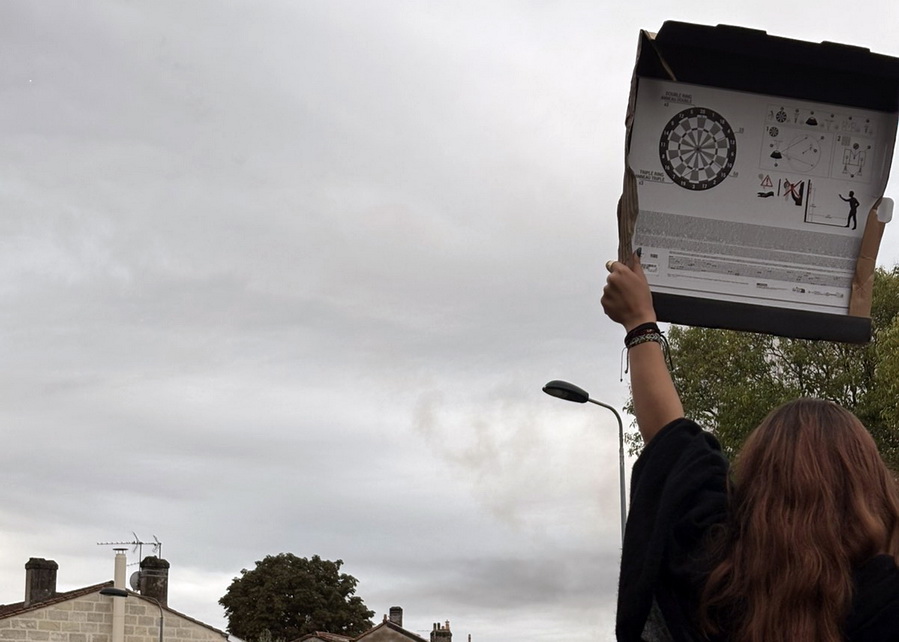

The morning outside the Bordeaux lycée began not with the usual school bell, but with the sharp crack of firecrackers, plumes of colored smoke, and barricaded gates. Crowds of teenagers chanted energetic slogans, passing cars honked in encouragement, and cardboard banners with red lettering swayed above the crowd.
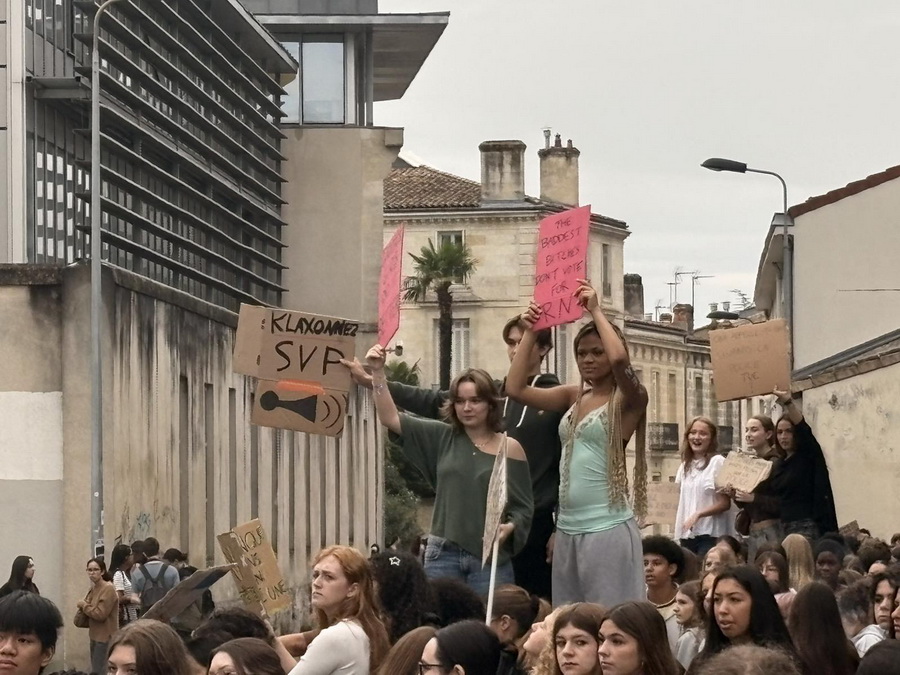
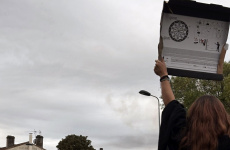
One detail caught the eye immediately: on the back of a sign raised high into the gray sky, right behind fiery anti-reform slogans, was a factory diagram of a dartboard target complete with an illustration of the proper throwing stance. A student had simply grabbed an empty dartboard box from home and carried it straight to the protest line.
For my 18-year-old mentee, who recently completed his language adaptation class after arriving from Ukraine, the scene looked like an exotic outdoor spectacle. Recording on his phone, he went straight into the crowd to ask his peers what was going on. But for me—having worked directly on educational policy and the "New Ukrainian School" (NUS) reform—the moment revealed a far more calculated, adult dynamic beneath the surface.
Parroting the Opposition's Talking Points
Walking up to the picketers with a simple prompt—“Je veux comprendre qu'est-ce que c'est” (“I want to understand what this is all about”)—the young reporter captured two revealing responses.
The first male student offered an unvarnished truth: while regular students were blocking the gate demanding better funding for education, outside teenagers with zero connection to the school had joined the fray with pockets full of firecrackers simply to create noise and blow things up.
The second interviewee, a female student, recited a textbook catalog of grievances:
- grueling class schedules running from 8:00 a.m. to 5:00 or 6:00 p.m.;
- acute anxiety caused by the Parcoursup college admissions portal;
- chronic teacher shortages and missing substitutes;
- unbearable temperatures inside classrooms (freezing winters, stifling heatwaves).
The parallel is striking: these four arguments mirror, virtually verbatim, the social media messaging published by left-wing opposition figures, most notably MEP Manon Aubry. While political figures depict a catastrophic failure of the state, teenage activists repeat the talking points into the microphone, convinced they are driving a spontaneous grassroots uprising.
The Legal Paradox: A Strike That Doesn't Exist
Few outside observers realize that under France’s Code de l'éducation, high school students possess no legal right to strike.
The right to strike (le droit de grève) is strictly granted to salaried workers—namely teachers and support staff. For students, the law mandates an obligation of regular attendance (obligation d'assiduité). In legal terms, walking out of class to demonstrate is considered an unauthorized absence, and blocking the gate to prevent others from entering is an administrative infringement.
This is precisely why the event is never officially called a strike; it is labeled a blocus (blockade). Yet an unwritten cultural pact immediately takes over: school administrators and police officers stand watch at a discreet distance. Intervening forcefully against minors would instantly trigger solidarity walkouts by major adult trade unions and provoke a national public backlash.
Protest Geography: The Silence of Private Schools
The single most telling sign of the political nature of these demonstrations is where they actually occur.
The blockades, smoke grenades, and repurposed dartboard boxes take place almost exclusively at public schools (lycées publics). This is the natural recruiting ground for established student unions (such as the FIDL and MNL), which frequently serve as youth pipelines for left-wing political coalitions.
Only a few blocks away, behind the gates of state-contracted private schools (lycées privés sous contrat), an entirely different atmosphere prevails:
- The Parental Contract: Families pay tuition fees for structured learning, safety, and strict oversight; disrupted instruction is not tolerated.
- Strict Disciplinary Rules: Participating in an entrance blockade or bringing pyrotechnics leads to immediate suspension or expulsion without debate.
- A Different Culture: Academic focus and university portfolio building take precedence over street demonstrations.
While public school students are drawn into political friction surrounding national budget allocations, private school peers remain at their desks, steadily widening the academic gap.
A French Revolution or Political Street Theater?
To an observer shaped by Ukrainian history, youth taking to the barricades inevitably recalls monumental turning points: from the student Granite Revolution of 1990 to the November 2013 crackdown on students that ignited the Euromaidan.
Applying that template to France, however, is a fundamental misread.
In France, high school walkouts are not revolutions in the making; they are a five-decade-old ritual designed to release social tension. High schoolers manned barricades alongside university students in May 1968, shut down cities in 1986 over university reform bills, and maintained weeks of blockades in 2006 against labor legislation.
The fundamental differences remain clear:
- The Core Objective: Ukraine’s uprisings centered on existential, geopolitical identity, freedom, and checking authoritarian overreach. The French protests represent localized socioeconomic bargaining within a rock-solid constitutional framework.
- Institutional Resilience: A few burned garbage bins and isolated firecracker bursts outside school gates are routine public order management for French authorities. The unrest predictably dissipates as soon as school vacations arrive or exam deadlines draw near.
A Contrast of Perspectives
Ultimately, the most telling contrast lies in perspective. Politicians broadcast narratives of systemic collapse, while restless teenagers light firecrackers along the perimeter.
Meanwhile, an 18-year-old Ukrainian student slips quietly through an open side gate into a quiet, half-empty building. There, his computer science teacher waits patiently, spending the quiet morning hours walking him one-on-one through complex Python algorithms.
Where local political rhetoric sees an unmitigated crisis, an outside perspective discovers a functioning environment of respect, safety from bullying, and practical opportunity. As for the homemade sign backed by a dartboard manual, it remains a vivid emblem of French political culture: an elaborate, impassioned theater where every participant already knows their lines.






Залишити коментар