

The baseline principle of the journalistic community regarding public corruption must remain unequivocal: society holds an inalienable right to receive verified and objective reporting on government conduct, and no regional military administration possesses the authority to grant or deny media access based on an editor's editorial compliance.
National security and the political convenience of state officials are fundamentally distinct concepts; in practice, they are entirely incompatible.
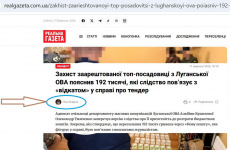
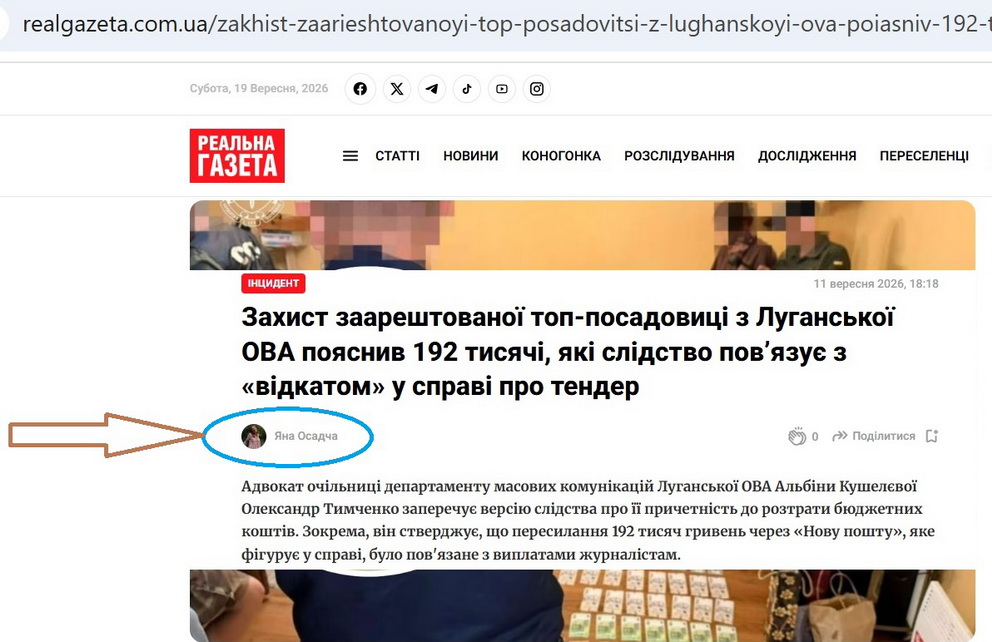
The criminal proceedings initiated by the Security Service of Ukraine (SBU) concerning Albina Kusheleva, Director of the Mass Communications Department of the Luhansk Regional State Administration (OVA), along with the documented postal transfer of 192,000 UAH in physical cash, extend far beyond individual defendants or their intermediaries. This case serves as a critical indictment of professional solidarity within the wartime press corps.
Where Professional Standards Supersede Industry Rivalry
Press freedom functions effectively only when an essential premise is maintained: governing institutions must tolerate and respond to critical inquiries from scrutiny they find inconvenient.
Protecting the right to report is not limited to an individual outlet’s access to government briefings. It requires defending the institutional right of every independent journalist to scrutinize executive decisions. When factual public interest investigations are dismissed as mere "targeted PR smears" (chorniy piar), and regional outlets publish arguments reframing unrecorded cash kickbacks as informal "reporter stipends", ethical journalism is fundamentally compromised.
Freedom of expression is rarely extinguished solely by administrative bans; it erodes when unaffected journalists assume that peer suppression does not concern them, rationalizing their passivity with the belief that internal stability suffices.
Budgetary Filtering as an Instrument of Selective Influence
This institutional fragmentation did not develop in isolation. Displaced media entities from the Luhansk region—deprived of equipment, physical newsrooms, and commercial revenues—faced severe operational constraints. Rather than establishing an equitable, transparent support system for all relocated media professionals, administrative leadership deployed state resources to cultivate selective allegiance.
While frontline reporters operated without baseline institutional aid, selected editorial personnel were incorporated into exclusive allocation frameworks. The documented selection—under the OVA's preferential 3% housing loan scheme (Executive Order № 260)—of both the direct family member of the department head (receiving 2.32M UAH in treasury disbursements) and an editorial executive whose reporting actively defended that same official (receiving 2.17M UAH) establishes a systemic conflict of interest funded by public taxpayers.
Imposing criteria such as high formal income thresholds and mandatory cash advances within compressed two-week processing windows systematically excluded vulnerable displaced families with dependents. A program chartered as social relief effectively served as an exclusive asset acquisition vehicle for connected personnel.
Institutional Independence: Separating Security from Administrative Control
To prevent regional information ecosystems from operating under the discretionary authority of a single administrative directorate, concrete structural reforms are required:
- Abolition of "State Media Coverage" Procurement: Official press releases and administrative decrees must be distributed through free public portals. State budget allocations must be directed exclusively toward competitively awarded public interest content managed independently of regional executive boards.
- Autonomous Oversight Councils: Media grant distribution must be governed by professional boards comprising media law specialists, human rights monitors, and accredited reporters, explicitly excluding executive OVA personnel from voting procedures.
- Mandatory Transparency on Subcontracting: Media contracts financed through public funds must enforce strict disclosures of end beneficiaries. Any redirection of state funds through intermediary sole proprietorships for cash conversion must mandate immediate contract termination and legal referral.
Press freedom is not an insular professional safeguard; it is a vital public utility. A society navigating war and sustaining the state budget requires an uncompromised press to track public expenditures and ensure regional governance remains transparent and legally accountable.







Залишити коментар