


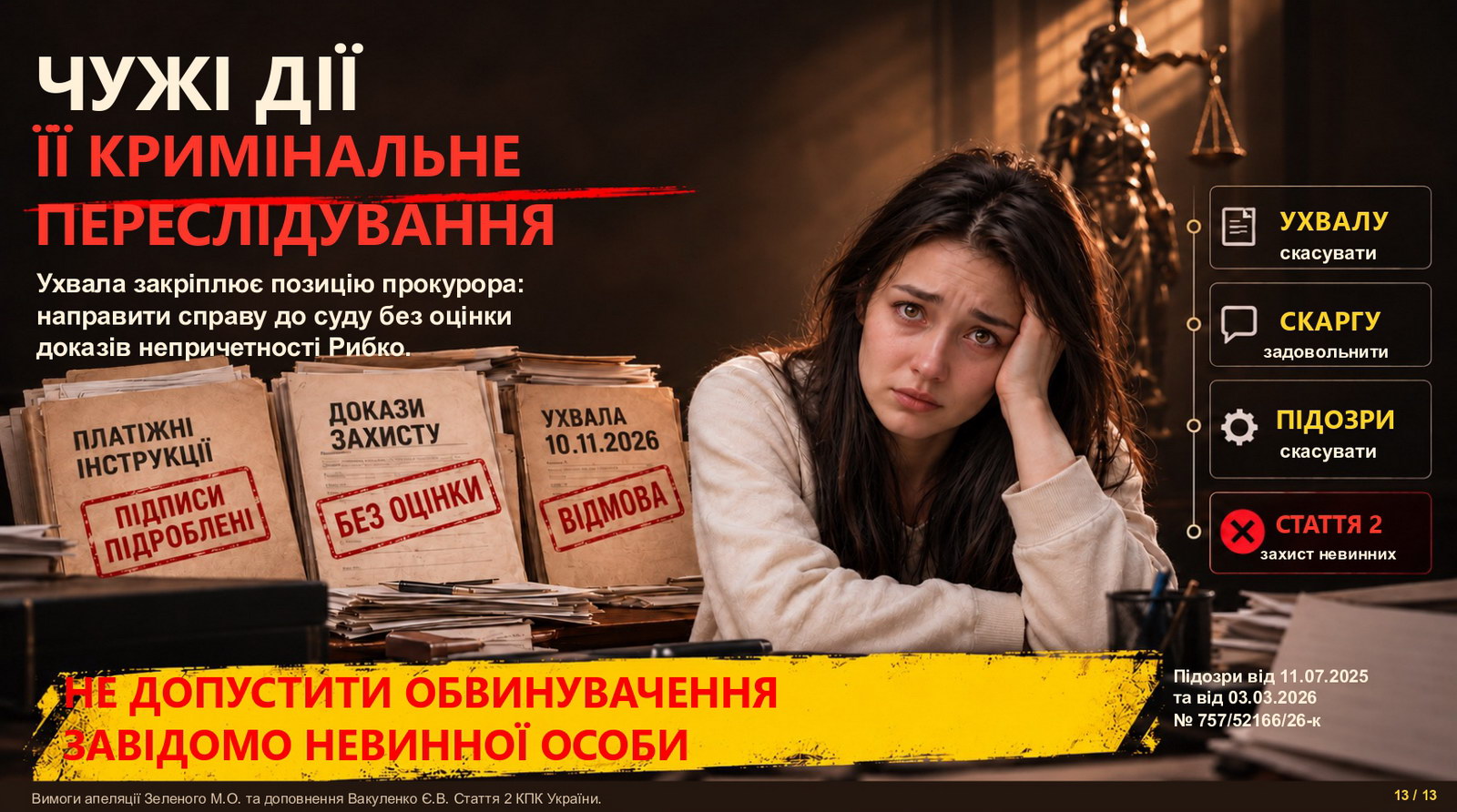

In the high-profile criminal proceeding No. 12023000000001103 concerning the embezzlement of state agricultural grants for planting walnut orchards in the Kyiv region, the prosecution's primary "target" has become 27-year-old Kateryna Rybko—the former nominal director of LLC "Gorikhovi Sady," who was in the United States when the funds were spent. In an interview with Dialogue Party, defense attorney Yevheniia Vakulenko explains how the scheme operated technically, why prosecutors from the Office of the Prosecutor General ignore 10 court rulings and clear evidence of forged signatures, how Judge Oleg Solovyov blocked a forensic examination for 139 days, and why the defense itself filed a criminal complaint over offenses committed against Kateryna.
— Ms. Vakulenko, the prosecution claims that your client, as head of the company, managed the bank accounts and signed documents through state electronic services. How were the digital keys in "Diia" actually created, and who held them?
— In the "Diia" application, biometric facial identification works for individuals, but a legal entity has no biometric data. For businesses, there is a separate service for generating an electronic digital key—both the director's signature and the electronic seal. My client generated this key together with the actual organizer of the scheme, and the defense file contains an audio recording and transcript of that procedure. On the recording, you can clearly hear this man bringing her to a service center where everyone knows him, directing the staff's actions, setting the password himself without telling the young woman what it is, and taking the key files away with him. In other words, from the very moment they were created, the keys of LLC "Gorikhovi Sady" were exclusively in the organizer's possession—my client had neither the files themselves nor the password to access them.
— Where were the grant applications technically submitted from?
— The pre-trial investigation authorities themselves tracked the IP address. During operational-investigative measures, it was established that all grant applications were sent from an IP address registered in the village of Rulyky in the Kyiv region. The service contract for that network was signed by another key suspect and de facto organizer of the scheme, whom my client had never even met.
(Editor's note: According to the publicly available ruling of the Pechersk District Court of Kyiv dated November 10, 2026, in Case No. 757/52340/26-k, V.M. Dulich and V.O. Bielous are named as suspects in the criminal proceedings).
— How were the funds withdrawn from the company's bank account? Did she sign the payment orders?
— Until June 17, 2026, when we began reviewing the case files, we did not even know that transfers from the current account were made not via remote online banking, but physically—on paper. Under the terms of the grant program, every payment had to be approved by the bank. Therefore, paper payment instructions bearing the director's physical signature were used, and a bank employee verified the signature against the specimen signature card and confirmed the intended purpose of the payment.
Without exception, all payment instructions and primary accounting documents of the company—not only during the payment period, but across a much broader timeframe from December 2022 (when the LLC was incorporated) through March 2024 (when V.M. Dulich transferred Kateryna Rybko's corporate share to another controlled individual, Khomenko)—contain either a forged handwritten signature of my client (an attempt at imitation by another person) or a facsimile created without her consent or knowledge. She did not sign a single business or financial document.
— How does the prosecution explain in court the fact that the signatures on the payment orders are forged?
— The prosecution has only one explanation: so what if the signature is forged—she allegedly handed over the right to manage the funds to someone else. When I asked directly in court, "If you believe she transferred the right of disposal to another person, why didn't that person sign the payment orders with their own signature instead of forging my client's signature?"—prosecutor Adrian Lupu replied, "Go ask him."
— Where did the money go after those payment instructions?
— The funds were transferred to a pass-through company whose director subsequently converted them into cash and handed the cash over to the scheme's organizer—this is explicitly stated in the text of the notice of suspicion itself.
(Editor's note: According to court registry records and case materials, the director of the recipient company is identified as Onishchenko / Anishchenko).
— What is the procedural role of the officials at state-owned "Oschadbank" who approved these payments and signed the inspection reports?
— Seven bank employees are charged under Part 2 of Article 364 of the Criminal Code of Ukraine (abuse of power or official position). According to the investigation, they failed to properly monitor the implementation of the grant program: sometimes without visiting the site at all, and sometimes without properly inspecting the land plots, they signed reports confirming that the grant was allegedly being executed properly. In doing so, they created the appearance before the ministry that the funds were being used for their intended purpose. However, the investigation severed the materials regarding the bank employees' falsifications into a separate criminal proceeding, to which the defense has been denied access.
— Back on June 25, 2026, the defense petitioned Pechersk District Court Investigative Judge Oleg Solovyov to order a comprehensive handwriting and technical forensic examination of these documents. Why did the court only rule on it in November?
— The law gives an investigative judge five days to consider such a motion. Instead, it sat in court for 139 days, and on November 11, Judge Oleg Solovyov dismissed it without consideration on the merits, citing the fact that on July 2 the investigation had announced the completion of the pre-trial investigation and opened the case files. In other words, the investigative judge failed to review the motion on time and then cited a change in the procedural stage that occurred after the statutory deadline for reviewing the petition had already expired. At the hearing itself, the investigative judge did not ask the parties a single question, and the one-and-a-half-page ruling fails to address a single argument raised by the defense—one gets the impression that the decision was written not by the judge, but by the prosecutor himself. We have already appealed this ruling.
Moreover, since both the investigation and the court refuse to verify the blatant forgery of documents, the defense has already filed an official criminal complaint regarding offenses committed against Kateryna Rybko herself—specifically, the forgery of her signatures to embezzle grant funds. However, both the prosecutor and the investigator are ignoring this complaint and unlawfully refusing to enter the information into the Unified Register of Pre-Trial Investigations (URPI); the investigator merely stated that, in his opinion, a suspect cannot be the victim of another crime. The defense challenged this unlawful inaction and obtained a ruling from an investigative judge on November 17, 2026, ordering the authorities to register the case in the URPI. Yet that court order—just like 10 other court rulings in total—is not being enforced by the pre-trial investigation body; it is simply ignored. Failure to comply with court rulings constitutes a separate criminal offense, this time committed by representatives of the prosecution. Honestly, it is demoralizing, because a criminal complaint against prosecutors of the Office of the Prosecutor General (the November 17, 2026 ruling specifically concerned prosecutors) must be filed with the State Bureau of Investigation (SBI), while procedural oversight will still be exercised by those very same prosecutors from the Office of the Prosecutor General.
— The prosecutor amended the charges, accusing your client of participating in an organized criminal group on an equal footing with the beneficiaries. How does this align with criminal law?
— When an investigative body alleges an organized group and a defined structure, the law requires clearly establishing each individual's role—who is the organizer, who is the perpetrator, who is the instigator, and who is the abettor—and applying Articles 27, 28, and 29 of the Criminal Code of Ukraine. Even by the investigation's own logic, individuals brought in merely for the formal registration of companies cannot bear the same criminal liability as the organizer for acts they neither committed nor encompassed within their intent.
Furthermore, Article 27 of the Criminal Code was still included in the initial notice of suspicion, but in the amended notice the prosecutor removed it altogether in order to equalize liability across all defendants. Notably, the organizer recruited as nominal directors not only a relative's 23-year-old sister, but also, for instance, his own 57-year-old mother-in-law, who is now likewise forced to attend court hearings and prove she had nothing to do with the financial transactions.
— Your client was 23 years old when the company was registered. Is the nominal incorporation of a company a crime in itself?
— There is nothing unlawful about incorporating a company and opening a bank account—in international practice, such as in Cyprus, there is an entire industry of pre-registered "shelf companies." The only actual transaction my client carried out was contributing her own personal funds to the company's authorized capital, which is also completely legal.
Criminal liability begins where a person signs business or financial documents for transactions whose substance they do not understand. My client did not participate in a single business transaction.
— In your view, why do investigators and prosecutors so confidently send cases with unverified evidence and forged signatures to trial, without fearing that the prosecution will collapse?
— There is a fundamental doctrinal flaw in the current Criminal Procedure Code. On paper, the law grants the defense a wide range of tools, but in practice almost all of them are blocked. Because Ukraine abolished the mechanism for returning a case for additional investigation (an indictment can only be returned to the prosecutor on purely formal defects, never for lack of substantive evidence), the investigation can do whatever it pleases at the pre-trial stage and simply "dump" the case into court.
Then the mechanism of multi-year delays kicks in. This proceeding involves 18 defendants, each represented by one or more lawyers. Under our judicial practice, all 18 defendants and their defense counsel must be present at every hearing, even when an episode concerning only one individual is being heard. If even one person falls ill or cannot attend, the hearing is adjourned. As a result, cases stall for years and decades at the preparatory hearing stage and are eventually dismissed under the statute of limitations.
That is why we see the exact same pattern every time: first loud detentions and arrests, then the release of key figures on bail, followed by silence, years of courtroom gridlock, and zero actual convictions for embezzling public funds. Meanwhile, an innocent person is forced to spend years proving their non-involvement, while every attempt by the defense to conduct a basic handwriting examination—which we have been fighting for over the past five months—is systematically blocked.
As a human rights defender, this raises a rhetorical question for me: why has the practice developed where all violations and flaws of the pre-trial investigation are not resolved during the investigation, but are pushed off to the preparatory court hearing once the indictment reaches the court? In criminal justice, there are three standards of proof:
-
First: reasonable suspicion (probability of evidence)—when information is entered into the URPI (the data indicates that the described events more likely occurred than not);
-
Second: sufficiency of evidence—when the pre-trial investigation body has gathered enough evidence to serve a notice of suspicion (the data indicates with sufficient certainty that the events recorded in the URPI were committed specifically by the person served with suspicion);
-
Third: beyond a reasonable doubt—until guilt is proven beyond such doubt, all doubts must be interpreted in favor of the suspect or accused. No one is obliged to prove their innocence and must be acquitted if the prosecution fails to prove guilt beyond a reasonable doubt. Suspicion and indictment cannot be based on illegally obtained evidence, particularly evidence that is blatantly forged.
In our specific case, it was at the second stage, when K.O. Rybko was served with a notice of suspicion, that the authorities began ignoring the evidence gathered by the defense:
-
Kateryna Rybko could not physically have committed the offense (disposing of, embezzling, and laundering grant funds) because, as Trump would say, there was a "beautiful ocean" between her and the events in Ukraine—she was in the United States.
-
All of her signatures, both on the payment instructions and across the entire body of financial and business records, are forged and were executed without her knowledge or consent.
We have now reached the stage where the prosecution was required to gather irrefutable evidence (resolving all contradictions pointed out by the defense) and prove beyond a reasonable doubt that Kateryna Rybko committed the crime. Specifically, the prosecution had to explain and prove how she, while in the United States and having zero contact with any of the co-defendants, took possession of funds in Ukraine (the grant money never crossed the Ukrainian border), laundered them, and received them in cash in Ukraine—all while every signature on the documents is forged. That claim sounds absurd on its face, yet not to the prosecutors of the Office of the Prosecutor General—A.K. Lupu and I.I. Goliney. Investigative judges refuse even to listen and dismiss the defense's evidence by pointing to the trial on the merits once the indictment reaches court.
This distorted understanding of criminal procedure stages in our case leads directly to drafting an indictment against a patently innocent person who was absent from the scene of the crime and took no part in the events the prosecution characterizes as criminal.
— What is the overall defense strategy and what are the prospects for this case?
— Going by the letter of the law, such a suspicion should never have left the investigator's office. We have already assembled more than enough evidence to dismantle this case on the merits, as it rests on three indisputable facts:
-
My client was not physically in Ukraine at the time of the offense, as she had departed for the United States.
-
She did not participate in any financial transactions, as all of her signatures were forged.
-
She had no knowledge of the crime and had no contact with any of the suspects after leaving the country—the only person she stayed in touch with was her own mother. As for the existence of a "criminal organization" that prosecutors are trying to ascribe to her, the prosecution has no evidence whatsoever.
Unfortunately, in our reality, investigators and prosecutors often fail to distinguish between formally following instructions and criminal liability for prosecuting a knowingly innocent person. When we remind them of the presumption of innocence in court, it is met with open laughter. And one need not look far when a presiding judge declares that the Constitution is just empty words—a set of rules that nobody reads and nobody follows.
In fact, if judges performed their primary function—acting as that filter and independent arbiter between the prosecution and the defense—my client would have been cleared from this case long ago. Regrettably, however, double standards prevail and genuine adversarial proceedings are absent: in court, the prosecutor is a priori always right, while the defense is always viewed by the system as guilty and unwelcome. That is precisely why publicity and public oversight in such trials are critically important today.
Yet, in violation of Article 6 of the European Convention on Human Rights, nobody listens to us—neither the prosecutor and investigator, nor the court. The doubts raised by the defense are not resolved, but openly ignored. Given these prospects, a knowingly innocent person will be served with an indictment built on forged evidence and will spend decades proving her innocence—likely until the actual perpetrators escape liability on their own through the statute of limitations.







Вікторія
Ось так в країні відбувається повне беззаконня, відсутність правової системи як такої, свавілля з боку правоохоронних органів, а страждають звичайні люди. Бідна дівчина…
Катерина
Щиро вдячна Вам, Сергію, за висвітлення цієї жахливої ситуації. Для мене це дуже важливо.
Світлана
Надзвичайно показова справа, яка порушує питання не лише долі конкретної людини, а й функціонування всієї системи правосуддя в Україні. Якщо докази підроблення підписів, використання електронних ключів сторонніми особами та невиконання судових ухвал залишаються поза належною увагою правоохоронних органів, виникає закономірне питання: наскільки захищеним може почуватися кожен громадянин? Коли адвокату доводиться боротися не лише за права клієнта, а й за дотримання самими правоохоронними органами вимог закону, це вже питання до всієї системи правосуддя. Повага Євгенії Вакуленко за професійність та принципову позицію. Конституція не може бути пустим звуком у державі, яка декларує європейські цінності.